
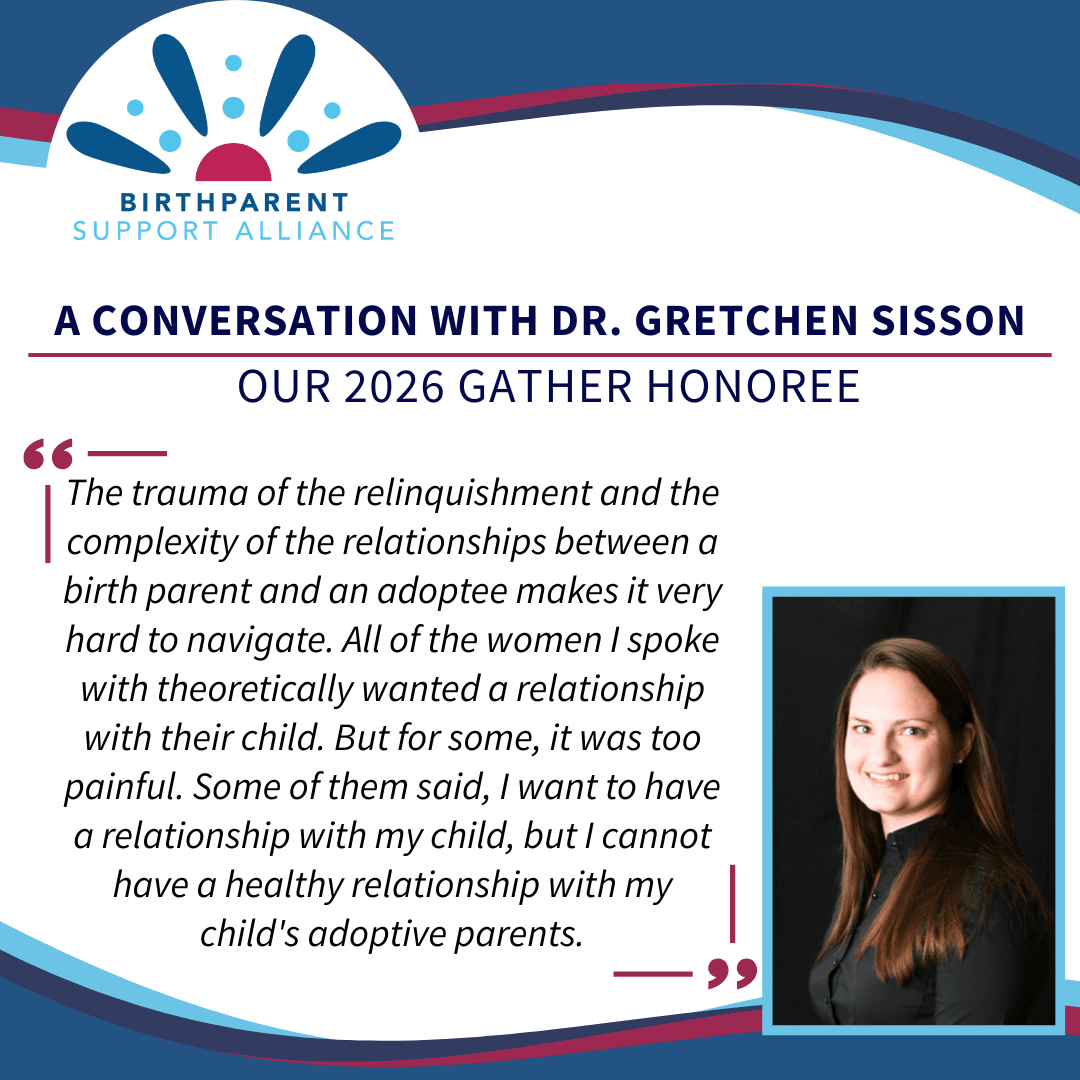
This year we are thrilled to announce Dr. Gretchen Sisson as our Gather 2026 Gala honoree. Last year we had the opportunity to sit down with Dr. Sisson to talk about her book Relinquished: The Politics of Adoption and the Privilege of American Motherhood. Sisson is a qualitative sociologist studying abortion and adoption at Advancing New Standards in Reproductive Health (ANSIRH) in the Department of Obstetrics, Gynecology, and Reproductive Sciences at University of California, San Francisco. Her research was cited in the Supreme Court’s dissent in Dobbs v. Jackson Women’s Health Organization and has been covered in The Washington Post, The Nation, and All Things Considered, among many others. She is a compelling new voice in the conversation about reproductive justice, abortion, and adoption, highlighting and centering the experience of women who relinquish infants for private adoption.
What is your connection to adoption? How did you get into a place of adoption research?
People ask me this all the time: are you a birth mother? Are you an adoptee? And I'm not. I came to my adoption research from working in other areas of reproductive health and justice. I initially started doing my adoption research when I was in graduate school, while I was interning at an organization called the Massachusetts Alliance on Teen Pregnancy. We were doing a lot of work with pregnant and parenting mothers, to change the Boston Public Schools pregnant and parenting student policy, and increase support for young families across Massachusetts. This is when the show 16 and Pregnant started on MTV, and, as you can imagine, the young mothers that I was working with were very interested in the show and how these stories about young mothers were being told. This show, by design, was intentionally stigmatizing teen pregnancy and young parenthood. That was the idea, to make teen motherhood look so terrible, that teens would take greater measures to protect themselves from getting pregnant. There was this one story arc on Catelynn and Tyler, a couple who relinquished their daughter, Carly, for adoption. Afterwards, they were held up as this poster couple for adoption. In the frame of the show, they become better parents because they had given up their daughter. That was really compelling to me, because the young parents we worked with were literally lobbying at the state house asking for what they needed to care for their children, and they were 16 or 17 years old. These are the young mothers that we're stigmatizing? The ones who were fighting for themselves, their families, their children? And society just tells them, Oh, if you just give your child to this middle class family, that's better.
But there were a lot of other parts of my work that were coming together at the same time. The Girls Who Went Away had come out a few years earlier, so I was already thinking about adoption in the context of that history. I was also volunteering at the Eastern Massachusetts Abortion Fund in Boston, so I was hearing these stories of people who wanted to get an abortion, but couldn’t afford it and didn’t know what to do, so we tried to help them figure out how to afford it, to take control of their reproductive lives. I was also working on my master's thesis, which was looking at infertility and how couples were making decisions about what to do when they are faced with infertility and they're trying to build their family. In all of these areas, this idea of adoption as a panacea kept popping up. If we just take the babies from these families and move them to these other families, then we don't need to provide insurance coverage for infertility treatments. We don't need to invest in vulnerable and young families. We don't need to make abortion accessible or affordable. We just introduce adoption, and the “problem” is solved. That's when I started wanting to look at adoption much more in depth.
I started doing my interviews in 2010, and then I re-interviewed a lot of the women in 2020 to see how their feelings about their adoptions had changed over time. This work came from wanting to more closely examine how adoption functions in our conversations about reproductive justice, what it actually means to support families, what it actually means to empower people to make the choices that are best for them, their children, their families, their communities.
Can you touch briefly on some of the trends or patterns you saw in how women perceived and experienced their adoption?
When I started the interviews, some of the women who were in pretty recent adoptions – who had relinquished in 2009, 2008, 2007, 2006 and were just three, four or five years out from their adoptions – spoke really positively about their adoption experience. Whereas once you got further down the line, everyone was super critical. So my question was: is adoption getting better and that's why people with more recent adoptions are happier? Or, does everybody just feel more negatively about their adoption over time? That's why I wanted to follow them and see if their feelings were the same 10 years later – and the answer is no. No one felt better about their adoption. Ten years later, most of them felt much worse. There were maybe one or two that were fairly consistently positive. They still had plenty of critical things to say, even if they were happy. I interviewed one woman in 2010, and her son had just turned one. She felt like she had the best adoption ever. She had a very close relationship with her son's adoptive parents and talked about how her son had a picture in his nursery of her, how she was invited to his birthday party and his christening and all these first year milestones. And I asked her: What do you think adoption should look like? And she said, Like mine! Then ten years later, I said, This is what you told me ten years ago. Does that still feel right? And she said: This adoption should never have happened. It was a complete 180. She still had a good open adoption, but her relationship with his adoptive father was really tough. Her relationship with adoptive mother was still good. She was very close with her son, he would come over and spend some weekends at her home with her and her new husband. But her son was neurodivergent, and had some challenges that she felt his adoptive parents really struggled with. She felt that actually she could have been a better parent for him in meeting those special needs than his adoptive parents were. The man she had ended up marrying, her husband, had some neurodivergent tendencies. So he and her son were very close. He would have been a great stepfather to him. The circumstances of her life had changed and had changed very quickly. About a year after our first interview she got married, and, while she knew those first few years of parenting could have been tough, she realized that she was married, and financially stable, and able to give her son those things she wanted for him.
The question of regret is also harder for women who have gone on to have other children. When I asked them, how do you feel about the choices that you made? Many of them wish that they had been able to parent or had been in a position where they felt that they could parent. They felt like they made the best decisions they could have at the time. But they end up sort of feeling like their children are mutually exclusive. They'd say: If I had been parenting this child, maybe I wouldn't have met and married this partner and had these two or three other children. And so when I asked them if they wished they had chosen something different, I was asking them to choose between children. As one woman put it, I wish I could have all my children with me. I don't know what life would look like to make that happen. So I can't say that the adoption was the wrong decision. Because I love the life that I have, the partner I have now, the children that I have. I know my daughter is healthy, pretty happy, has a decent connection to me and knows that I'm always here if she needs me. If there was a way to snap my fingers and have all three of my daughters in one place. I would choose that.
Birth parents often wonder if they could have done something differently and I think for some of them that guilt is too scary of a place to go. I hear from some adoptees who say, Well, my birth mother doesn't want to have anything to do with me. Obviously, that's really painful to hear. When people ask me, Did all the women that you spoke with want to be in relationships with their child? Did you talk to anyone who didn't want to have anything to do with their kid? The trauma of the relinquishment and the complexity of the relationships between a birth parent and an adoptee makes it very hard to navigate. So all of the women I spoke with theoretically wanted a relationship with their child. But for some, it was too painful. Some of them said, I want to have a relationship with my child, but I cannot have a healthy relationship with my child's adoptive parents. Many of them talked about it like a sentence, and said, I have nine more years until my child turns eighteen and I can reach out to them directly. I think that it's important to know there's a theoretical desire to have a relationship with their child, but it's being actively prevented by something. And then there are other people who are able to have communication or relationships of varying meaning. They don't always necessarily get what they want.
What are some of the sterotypes you’ve witnessed about birth mothers?
There are a couple of archetypes of birthmothers. In my book, I look at pop culture and storytelling, and I have a chapter that looks at these myths around birth-motherhood. One myth is the “Juno” myth, this idea that closed adoption is an easy, obvious choice. You place the baby and are sad for a minute, and then a day later you're off riding your bike and happy and moving on. That is one common trope, that adoption is a really easy, straightforward decision with few emotional, physical, logistical ramifications for the mother. The other common trope is the trope of the “scary birth mother,” the baby-stealing birth mother who is going to want to take the baby back. You see that a lot in popular culture as well. Both of those archetypes come out of the same place; they come out of the idea that involving a birth mother is dangerous and scary and risky in some way. On one hand you have this Juno character as a kind of wish fulfillment, where the birth mother doesn't even want to be involved, which leads to this idea that a “good” birth mother doesn't even want or need to be present. If they do need or want to be present and involved, then that's a threat to the adoption itself. We don't have a model for what it means for a birth mother to be continually involved in their child's life in the adoptive family in a way that is meaningful and productive for all parties involved. We don't have models for what open adoption is, both for the people who have to live it, but also for people outside it. Even though openness is the norm in adoption, it remains an oddity in our broader cultural idea of adoption, and people who live in an open adoption are constantly having to figure out this relationship on their own in a world that doesn't understand what that looks like. I think that's why you have these contrasting myths about birth motherhood: one that a mother doesn't need, or want openness—let alone what a child needs or wants—and then the opposite where any involvement is inherently dangerous. Both tropes offer no model for what most adoptions actually look like today, which makes it even harder for families that are trying to make open adoption work.
Did any of the women that you interviewed talk about Post Adoption Contact Agreements (PACAs) or share about any instances of reversed open adoptions or situations where parents decide later to close them?
Yes, only a few of them had verbal or written agreements. Oftentimes, if they were written, they believed that they were legally binding in some way and only later found out that they weren't. And a lot of mothers had less contact than they wanted, or than they hoped for, or than they had been led to believe they were going to get.
I think that if some degree of openness didn't exist, 90% of the mothers that I interviewed would not have relinquished. They had basically no interest in closed adoptions, and openness was the only condition under which they would have relinquished. I think open adoption is better and healthier than closed adoption. I think it changes the shape of what the adoption trauma looks like for relinquishing mothers – but it's also good marketing. It is a necessary condition for a relinquishment to happen.
I interviewed a few mothers who had very radical open adoptions. They were babysitting their children, spending weekends together or going on family vacations with the adoptive family. One of my favorite examples is of a woman who I asked, when was the last time you saw your child? She said, oh, when did I see her last? I haven't seen her for a few days. But I saw her dad this weekend, because I was buying a new TV and they have a really big truck. So her dad drove me to BestBuy to pick up the TV because they have a truck. It was as if someone were to ask: when did you last see your brother-in-law? She's truly part of their family. She sees them all the time, has a really good relationship with both adoptive parents and feels very comfortable with them and they feel very comfortable with her. And importantly, the adoptive parents have never viewed her as a threat. When her daughter was eight years old she asked, can I call you mom? And she said, well, look, why don't you talk to your mother? She knew that her adoptive mother would encourage their daughter to call her mom if she wanted to, and so she did. She tried it out for a little while and then she went back to calling her by her first name. She said that felt more comfortable. This mother told me, I got extremely lucky. There was nothing about this system of adoption or the way I was counseled that led to this outcome. This was just an extremely good, close match with people who have always wanted me to be very deeply involved in my daughter's life and don't view my presence as a threat. And we happen to just get along really well. I see them more than I see my own sister. We're good friends.
One of the mothers I interviewed in 2010 talked about babysitting her one-year-old daughter for a weekend when her daughter's adoptive parents had to go to a wedding. And at the time, she was like, look at this beautiful open adoption that we have! I got to be with my daughter for the whole weekend. It was wonderful. I asked her in 2020, when we last spoke, you mentioned that you got to babysit your daughter for the weekend. And she said, oh yeah, did I tell you that she fell off the bed? She hadn’t mentioned that. I'm a mom, I have three kids, every single one of my kids rolled off the bed at some point; it just happens. And she said that she was so scared to take her daughter to the ER, because she was worried that that would lead the parents to cut off contact. So she set an alarm on her phone for every five minutes, so that she would wake up throughout the night to make sure that her daughter was still okay. She was insecure in their relationship and she was so terrified of jeopardizing it. It was certainly an open adoption, but she still had this insecurity and anxiety about their relationship which made it really hard.
On the other end of the spectrum, there were mothers who didn't know their child's last name or what city they live in. But because they had picked out the adoptive parents when they were pregnant, they were told that was an open adoption. Because they got pictures in the mail from the agency twice a year, they were told that was an open adoption. One mother I spoke to had in-person visits with her son once a year, and her son didn't know who she was. She was just a friend of his mom’s. She was considering cutting visits, saying, I think I'm gonna stop doing the visits, because they're painful to me. I mostly want to do this for his benefit, so that he has a relationship with me and he knows who I am. But if he doesn't even know I'm his mother, he's not getting anything out of it. I think I'm gonna stop the visits for a few years until his parents are ready. She was also parenting a toddler at the time and she'd bring her daughter to the visits, and she commented, my three year old knows that this is her brother. And I can't trust her not to say, ‘Oh you grew in my mama's belly!’ I'm not gonna get a babysitter for my daughter for eight hours so that I can drive and see him when he doesn't even know who I am. But again, on paper, that's an open adoption because she gets in-person visits once a year.
That really does show just how broad the spectrum of experience is in open adoption and that it's not a fix all. I do think that's part of the marketing: Do the adoption, because you'll have openness, and if you have openness, you won't have trauma.
Right. I talked about this in the book, but there are plenty of mothers who have lost older children to foster care and they're pregnant again and private agencies will say, if you do a private adoption, you get to choose the adoptive parents, and you get to have some degree of openness. You're highly at risk for losing this child to foster care but if you choose private adoption, then you can be more in control and have openness. First, it's not a foregone conclusion that they're going to lose custody of this new child. Secondly, even if that child is in foster care, the goal is still reunification most of the time. And third, private adoption is a permanent legal solution in a way that foster care is not intended to be. Using the hook of openness to pull mothers into private adoption is very real, particularly for women who are at risk for family policing, Black women especially.
What would you say to somebody who asks, why do we need more research? What is the point of additional research on birth parents and adoption?
I think that not only the way that adoption is practiced, but the way that the general public thinks about adoption and understands the role of adoption, is so divorced from what adoption is actually like for the people who live it. I think for some people, it doesn't take much additional understanding to radically change how they understand adoption. Someone close to me was talking about wanting to adopt, and my question was: why? Why is that something that you're interested in? And she said, A lot of babies need homes. And I said, Well, actually . . . And this is someone that I care about and who is very well-intentioned. People generally are well-intentioned, and those intentions are complicated by whiteness, racism, and religion, and all these other things that shape those good intentions. But if you assume that people who participate in this system are doing so from a good place and you show what these actual stories and experiences look like, maybe they can take those good intentions in a different direction. Maybe they can pursue a different way of doing things that makes more sense given what we know now. I think that showing what the lived experiences of people are like is the best way forward.
You can learn more about Dr. Sisson's work by visiting her website, or find her on Instagram or Twitter/X. She is an active member of the Women Donors Network, and served as a member of the founding board of directors for WDN Action. In her work at WDN, she is a co-founder of the Abortion Bridge Collaborative Fund. The ABC Fund is a movement-led, rapid-response, trust-based philanthropy effort to address the post-Dobbs needs in abortion provision and protection across the country. Relinquished: The Politics of Adoption and the Privilege of American Motherhood was released on February 27, 2024, and is available at the bookstore of your choice.


