
We have been doing this work for a long time. And for most of that time, we have said quietly what we are now saying out loud: adoption should be a last resort.
Not because adoption is wrong. Not because adoptive parents are bad people or because birthparents made a mistake. But because far too often, people arrive at adoption not because it was truly their choice, but because no one offered them anything else. Because the system handed them a pen instead of a lifeline. Because they were never given the full picture, only the version that made everyone else more comfortable. That ends here.
What do we mean by "last resort?"
When we say adoption should be a last resort, we mean this: any expectant parent who wants to parent their child should have every opportunity to do so. Full stop.
This is not a judgment of birthparents. We are very clear about that. The people who come to us through Shared Journeys: A Birthparent Collective, our direct services organization, arrive having already placed. They arrive devastated, angry, at peace, grieving, relieved, and every combination of emotional response you can imagine. We meet them exactly where they are, with no agenda other than their well-being. There is no right way to feel about an adoption placement, and every person who comes to us knows that from the very first conversation.
What we are talking about is what happens before placement, and that work belongs to adoption agencies and professionals, not to us. We are here for after. But because we see after, we know what it costs when before isn’t done right.
Real informed consent isn’t a signature on a form. Beauchamp and Childress (2019), whose foundational framework governs biomedical and social work ethics, define informed consent as requiring three things: information sharing, decision-making capacity, and voluntariness. All three. Not one. Not two. All three. That means an expectant parent must have honest, complete information including the grief that follows placement, the complexity of open adoption, and the ways that placement reshapes a person’s life for decades to come. It means they must have the cognitive and emotional capacity to process that information and make a genuine decision. And it means that decision must not be shaped by financial desperation, social pressure, or a system that never offered them a way out.
The research tells us clearly that when these conditions are not met, the consequences are severe and lasting. Adopted persons and birthparents both experience significantly higher rates of suicide, mental health and behavioral health referrals, substance use, physical health challenges, and representation in the criminal justice system than the general population (Wiley & Baden, 2005; Brodzinsky, 2008). These are not fringe outcomes. They are patterns. And they are part of why we believe, without apology, that everyone entering the adoption constellation deserves honesty, preparation, and genuine support from the very beginning.
When that happens, outcomes improve for birthparents, for adoptive families, and for adoptees. That is the goal. That has always been the goal.
Whose Responsibility Is It?
Everyone’s. That is the answer, and we are not going to soften it.
Adoption agencies, attorneys, social workers, hospital staff, counselors: every professional who comes into contact with an expectant parent during what is often the most vulnerable period of that person’s life carries a piece of this responsibility. And it begins not with paperwork, but with questions.
Why is this person exploring adoption? What are they afraid of? What would need to be true for them to feel they could parent? And, crucially, is what they’re expressing a preference, or a resource gap? Because those are not the same thing, and treating them as though they are is one of the most consequential failures in adoption practice.
Here is something worth sitting with: the ability to write a check does not make someone a good parent. And the inability to write one does not mean someone will be a bad parent. Financial stability is a circumstance, and often a temporary one. Sisson (2024) found that for many expectant parents considering adoption, the financial threshold between feeling unable to parent and feeling able to do so was remarkably low, often only a few thousand dollars. Not a fortune. Not a windfall. A few thousand dollars that the system rarely offers, but that prospective adoptive families routinely spend many times over in agency and legal fees to complete a placement. Further, even when an agency or prospective adoptive parents have taken advantage of the duress of circumstances of poverty, courts have ruled that a birthmother is considered to have voluntarily consented to adoption (Seymore, 2023), a legal standard that falls grotesquely short of anything resembling genuine choice.
The same questions apply on the other side of the equation. Prospective adoptive parents deserve, and owe it to the children they hope to parent, an honest reckoning with their own readiness. Why are you coming to adoption? Have you done the emotional work? Are you prepared for the realities of open adoption? For raising a child who has experienced loss from the very first moments of their life? For raising a child who may not look like you, whose racial and cultural identity you are responsible for protecting and nurturing even when, especially when, that requires you to confront your own blind spots? For being part of an adoption constellation for the rest of your life, in ways you cannot fully anticipate today?
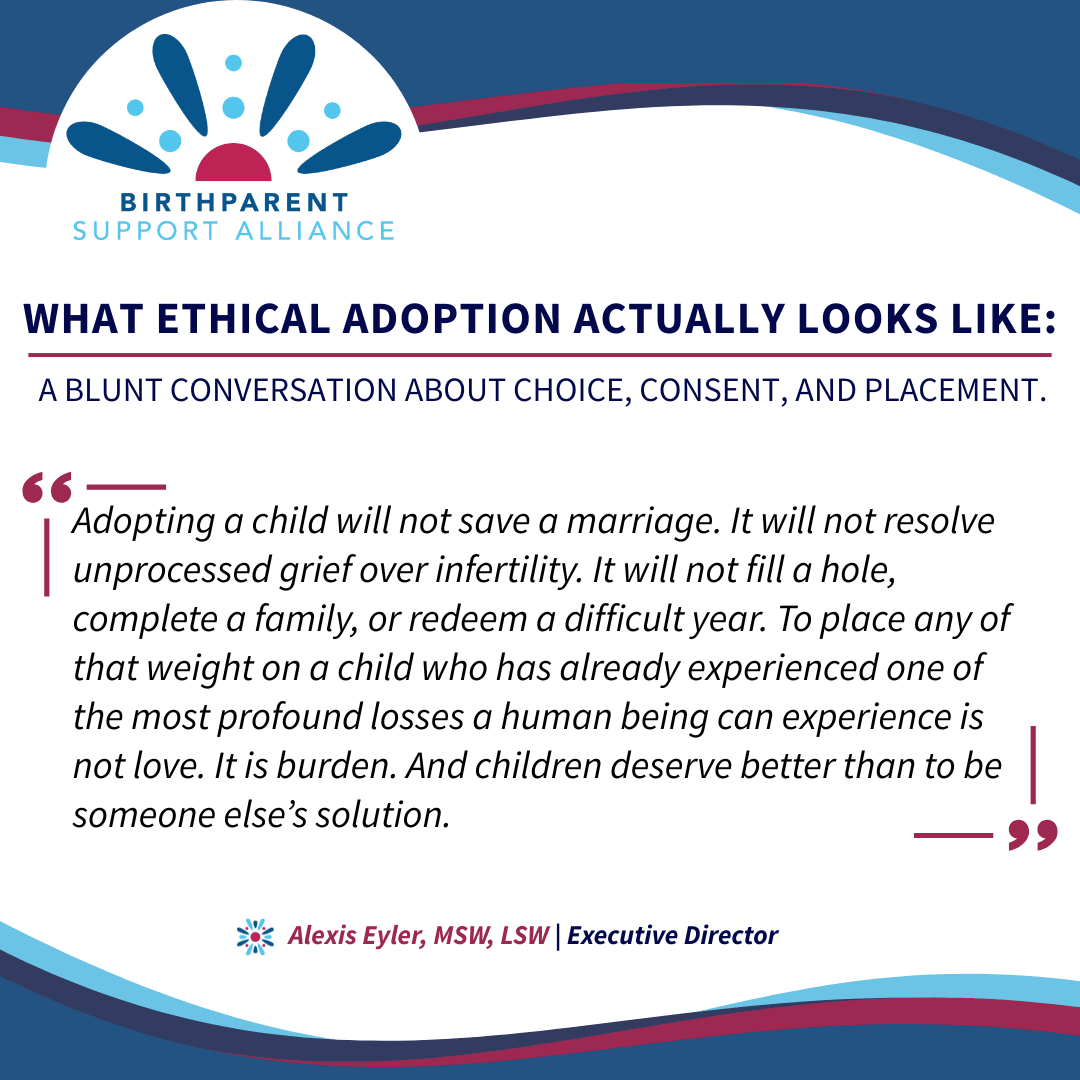
Adopting a child will not save a marriage. It will not resolve unprocessed grief over infertility. It will not fill a hole, complete a family, or redeem a difficult year. To place any of that weight on a child who has already experienced one of the most profound losses a human being can experience is not love. It is burden. And children deserve better than to be someone else’s solution.
These are not gatekeeping questions. They are not asked to disqualify anyone or to suggest that prospective adoptive parents are suspect. They are asked because the research is clear: when adoptive parents have done their own work, truly done it, outcomes are better for everyone, including and especially for the children at the center of every adoption (Brodzinsky, 2008). Before anyone adopts a child, they need to have arrived at a place of wholeness within themselves. Not perfection. Wholeness. Because a child who has already lost so much deserves a family that is ready to hold that, not one that needs the child to hold them.
A particular obligation falls on licensed social workers, who make up a significant portion of the pregnancy counselors and adoption professionals working in this space. The NASW Code of Ethics is unambiguous: social workers are bound to uphold client self-determination, to ensure informed consent, and to actively work to expand the options and opportunities available to clients rather than simply process the choices in front of them (NASW, 2021). Equally important, the Code calls on social workers to understand and address the ways that poverty, racism, and systemic oppression shape the circumstances of the people they serve. When a social worker is employed by an adoption agency, that obligation does not disappear. It becomes more demanding. The professional duty to the client, meaning the expectant parent sitting across the table, must take precedence over institutional interests, placement timelines, or the needs of prospective adoptive families. Social work ethics are not a checklist to be completed before a signature is obtained. They are a framework that requires asking hard questions, sitting with difficult answers, and advocating for the person in the room, even when the system is not designed to make that easy.
On Informed Consent When There’s a Crisis Underneath
This is where things get harder. And more important.
Consider this: most states have laws requiring that puppies remain with their mothers for a minimum of eight weeks before they can be separated and re-homed, a legal recognition that early separation causes measurable developmental and psychological harm. And yet in adoption, relinquishment papers are routinely signed while a birthing person is still in the hospital, sometimes within hours of delivery, before hormones have stabilized, before postpartum mental health can be assessed, before any meaningful recovery from the physical and emotional experience of birth has even begun.
We extend that protection to dogs by law. We have not extended it to mothers and their children.
The ethical floor is not complicated. Origins Canada (n.d.) articulates it plainly: informed consent to adoption can only be given once the mother has recovered from childbirth, pregnancy and birthing hormones have returned to pre-pregnancy levels, any resulting postpartum depression has been diagnosed and treated, and the mother has had significant bonding time with her baby in an environment free from coercive elements. That is the bar. And it is a bar the current system routinely fails to meet.
When an expectant parent is struggling with a mental health crisis or active substance use disorder, the ethical obligation is not to accelerate the process. It is to stop. To support. To connect that person with recovery resources, with mental health care, with the help they need to be in a position to make a genuine decision. Snoek and Horstkötter (2021) note that the dilemma in care for pregnant substance-dependent women involves a conflict between the maternal right to self-determination and the fetal right to non-harm, and navigating that conflict ethically requires compassion and real resources, (again) not a pen.
The same is true when there is domestic violence in the picture. Research on the intersection of intimate partner violence and substance use demonstrates that abusive partners frequently use coercive tactics that include undermining survivors’ recovery efforts and access to treatment and services (U.S. DHHS, 2020). A person being coerced, controlled, or unsafe cannot make a free decision. Professionals have an obligation to assess for this, and to respond to it, before any relinquishment process moves forward.
And all of this must be done with clear eyes about systemic racism. The data here is not subtle. Black women are three to four times more likely to die from pregnancy-related causes than white women, and that disparity persists across income and education levels. High-income non-Hispanic Black mothers have worse maternal and infant health outcomes than low-income non-Hispanic white mothers, which points to a system failure rather than individual behavior (Centers for Disease Control and Prevention, 2023). The system that is failing Black women in pregnancy is the same system making decisions about their parental rights. Pregnant Black women are four times more likely to be screened for drug use than white women, even without any prior report of substance abuse, and a Black mother’s refusal of medical care is twice as likely to be reported to child welfare services as abuse (Roberts, 2022). Adoption is too often sanitized in ways that erase issues of gender, race, and class (Seymore, 2023), and professionals working in this space have an obligation to actively resist those erasures rather than participate in them. Parents of color, and particularly Black and Indigenous parents, are disproportionately funneled toward relinquishment not because it is their genuine choice, but because the system has offered them surveillance instead of support.
Independent representation, meaning legal and counseling support that is entirely separate from the agency and the prospective adoptive family, is not optional in these situations. It is a basic ethical requirement.
And even when all of this is done well, even when independent representation is in place and resources are offered and the process is handled with genuine care, placing a child for adoption is one of the most complex emotional experiences a human being can navigate. The circumstances that bring someone to that decision are rarely simple, and the feelings that follow are rarely straightforward. Grief and relief can coexist. Love and loss are not opposites. A decision that was right can still hurt in ways that don't resolve on a timeline anyone else gets to set. This is precisely why Shared Journeys exists, and why we meet people wherever they are in that journey, whether they come to us weeks after placement or decades later. There is no expiration date on needing support, and there is no version of this experience that is too complicated, too ambivalent, or too far removed in time for us to hold.
What We Are Here For
We are not adoption abolitionists. We believe that adoption, done ethically and with genuine, informed consent, could be the right path for some people. We believe in open adoption, in honest relationships across the constellation, and in the lifelong nature of the connections that adoption creates.
What we will not do is pretend that adoption as it is currently practiced always meets that standard. It doesn’t. The birthparents who come to us tell us so, over and over again. They tell us that if someone had simply supported them, if resources had been available, if anyone had asked what they actually wanted, things might have been different. We listen to them. They are the experts on their own experience, and their voices are the reason this organization exists.
Neither the Birthparent Support Alliance nor Shared Journeys works with expectant parents. Our work begins after placement, and it is after placement that we first meet the birthparents we help. But we carry what we hear into every conversation we have about what ethical adoption practice should look like, and we will keep saying it out loud until the system catches up.
References
Beauchamp, T. L., & Childress, J. F. (2019). Principles of biomedical ethics (8th ed.). Oxford University Press.
Brodzinsky, D. M. (2008). Adoptive parent preparation project phase I: Meeting the mental health and developmental needs of adopted children. Evan B. Donaldson Adoption Institute.
Centers for Disease Control and Prevention, National Center for Health Statistics. (2023). Maternal mortality rates in the United States, 2023. https://www.cdc.gov/nchs/data/hestat/maternal-mortality/2023/maternal-mortality-rates-2023.htm
Henney, S. M., Ayers-Lopez, S., McRoy, R. G., & Grotevant, H. D. (2007). Evolution and resolution: Birthmothers’ experience of grief and loss at different levels of openness. Journal of Social and Personal Relationships, 24(6), 875–889.
National Association of Social Workers. (2021). Code of ethics of the National Association of Social Workers. NASW Press.
Origins Canada. (n.d.). Adoption coercion: What is adoption coercion? https://www.originscanada.org/adoption-practices/adoption-coercion/what-is-adoption-coercion/
Roberts, D. (2022). Racial discrimination in child welfare is a human rights violation. American Bar Association. https://www.americanbar.org
Seymore, M. L. (2023). Adoption as substitute for abortion. University of Colorado Law Review, 95. https://lawreview.colorado.edu
Sisson, G. (2024). Relinquished: The politics of adoption in the era of Roe v. Wade. St. Martin’s Press.
Snoek, A., & Horstkötter, D. (2021). Parental substance and alcohol abuse: Two ethical frameworks to assess whether and how intervention is appropriate. Bioethics, 35(9), 916–924. https://doi.org/10.1111/bioe.12920
U.S. Department of Health and Human Services, Office of the Assistant Secretary for Planning and Evaluation. (2020). Understanding substance use coercion as a barrier to safety and recovery. https://aspe.hhs.gov
Wiley, M. O., & Baden, A. L. (2005). Birth parents in adoption: Research, practice, and counseling psychology. The Counseling Psychologist, 33(1), 13–50.


