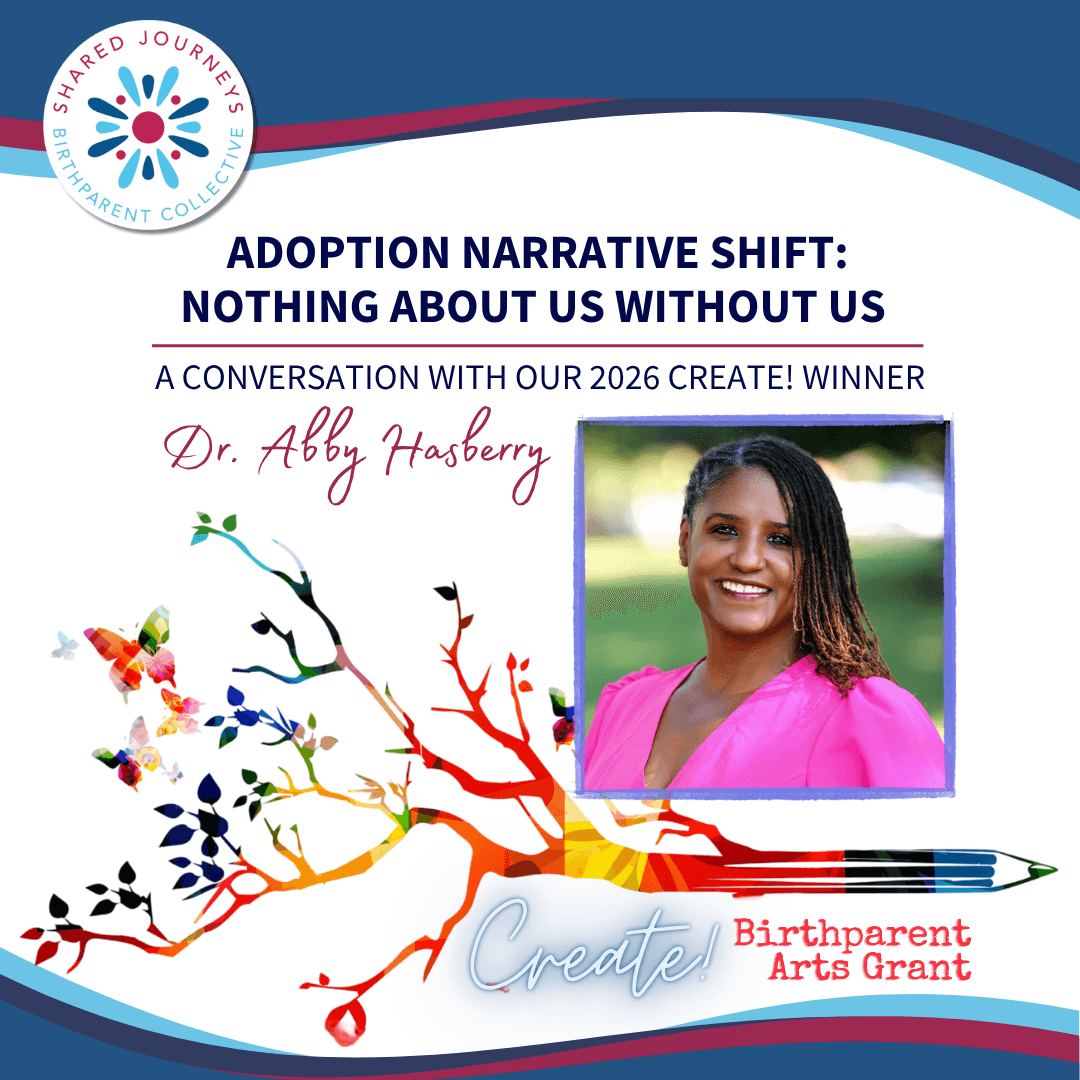
The Create! Birthparent Arts Grant applications we received this year were beyond anything we could have imagined, and we are lucky to have so many thoughtful, creative community members. It is always an honor to read every submission, and the final decision was a difficult one. This year’s winner is Dr. Abby Hasberry, a licensed marriage and family therapist, transracially adopted person, birthmother, researcher, and author of the memoir Adopting Privilege: A Memoir of Reinventing My Adoptee Narrative. Her project, an 11 part docuseries, will provide every part of the adoption constellation—including adopted people, birthparents, adoptive parents, siblings, partners, and estranged family members—a platform to speak for themselves rather than being spoken over, or for.
Without further ado, we’d like to introduce our Create! Birthparent Arts Grant winner, and let her tell us all a little bit more about herself, and her docuseries.
I am a transracial adoptee, from right at the tail end of the baby scoop era. I'm also a birthmother, who considers myself coerced to relinquish my son as a teenager. I currently am a therapist and am licensed in Michigan, Texas, and Maryland, and I work predominantly within the adoption constellation. I also do a lot of adoption-competency and informed consent training specifically for social workers, therapists, educators, lawyers, and medical professionals.
I'm currently working on an 11-episode docuseries that will speak to the constellation called Adoption Narrative Shift: Nothing About Us Without Us, which has me speaking to people within the constellation whose voices are almost never heard. For example, the first episode is me speaking with the siblings of adoptees - both biological and adoptive siblings - to ask them the questions that no one's ever really asked them, and each episode is a different group in the constellation that I interview.
Right now, it’s still considered revolutionary to hear adopted people and birthparents speak about adoption. This feels really groundbreaking, giving a platform to other members of the constellation whose lives are also impacted by adoption.
I'm doing an episode with the children of adoptees, asking them the questions that no one ever really asks them, which is a kind of extension of the experience I had after my memoir, Adopting Privilege, was published. After my youngest daughter read my memoir, we had conversations that we had never had before that helped her think of me as a full human and not just her mom! Most of my siblings, both adoptive and biological, have also read the book, and we began having conversations that we had never had before.
I gained a deeper understanding of what telling my story has done for my own family, and how they now can have conversations about their experiences with adoption and beyond that they had not had over the past 55 years of my life. Before my book, my siblings and I never talked about what it was like growing up with one adoptee in the family, or what their experience was, or even what my experience was, and I just felt like it was really important for people to hear the whole constellation speak about it.
One of my episodes is on adopted women who also relinquish, which is also my current research project. The research is done, I've analyzed the data, and I've uncovered interesting themes. I think it's going to be pretty groundbreaking work because no one that I could find has ever had these conversations with women who were both adoptees and subsequently relinquished a child, and the things that I found about our experiences are so identical in the way that we feel and the things that we've experienced and the reasons why we relinquished. It’s a more prevalent experience than we think. In Gretchen Sisson’s book, Relinquished: The Politics of Adoption and the Privilege of American Motherhood she mentions that of the I think thousands of women she has interviewed, about 20% are both adoptees and birthparents. And when I read that, I thought, there is a reason why this is happening, and I have to figure out what that is. I want to get this research into the hands of the people it affects the most.
You are creating a deep body of work that delves into the adoption constellation experience. Has anything surprised you as you work on these projects?
As an academic, it important to me that my work is IRB approved [ed. note: IRB stands for Institutional Review Board, an administrative committee that reviews and approves research involving human subjects to ensure ethical standards and participant safety] and that includes confidentiality, but so many of these women have already been silenced so much. A few of them have said, I don’t want a pseudonym. I want my name in it. I want people to know who I am because otherwise it feels like more silencing.
I think that that also is something that we should consider as researchers and people telling stories too. Is that, yeah, that confidentiality and anonymity is great, but it also can be harmful.
You have this whole body of work that's doing a deep dive into the constellation and into stories that are not being told, and now a docuseries that continues that theme. What draws you to telling these untold stories?
I think part of it is the fact that I've talked to so many people who are just shocked at how openly I tell my story. At first, I didn’t really understand that shock, but as a therapist and just as a person who talks to people I know that silencing is shaming, and I've known that since my PhD work, which focused on racial identity development. We silence children on race so much so that they're afraid to talk about it, and the silencing of stories is so isolating, and it really allows people to just kind of get enveloped by their own shame, and so it has been really important for me to empower people to own their own narrative and to also then tell their stories and encourage them to tell their stories.
That also stems from my own experience trying to find my information, which I'm still working on. I've been documenting my search for my original birth certificate, and I still don't have access to it. I have an appointment with Vital Records and a court order saying I can get access to it, but we will see. They can still say no. That feeling of having all these other entities write my story, and now taking back the ownership of that story, and then telling my story? I want everyone to have that power, and to feel empowered to do that.
I think a lot about the traditional adoption narrative, and amazing marketing that narrative has, that has us really believing one way about adoption and relinquishment, and the only way to counter that is by sharing stories. Sharing our stories is how we shift the narrative. That is how we change legislature. That's how we change informed consent. That's how we change the fact that lawyers represent the birthparents and the adoptive parents simultaneously, an obvious conflict of interest. All of these things won't shift unless we change the narrative and understand people's real lived experience.
Are you already filming the docuseries you created?
We are already filming. The project moves forward in spurts because I don't have full funding. I want to go as fast as I can, but I can only go as fast as money takes me. I have a phenomenal team: an Emmy-nominated filmmaker, a photographer, a videographer. And I have a phenomenal advisory panel that's made up of people within the constellation who will screen every episode before we finalize anything, to make sure that we are representing voices well and that we're not stepping on any toes or doing anything that might harm the community. That's really, really important to me. I've assembled a group of people who represent all parts of the constellation who can help me make sure that everything is told honestly and respectfully.
Once the docuseries is complete, what happens next?
There are a few different avenues for it. One path is taking it to film festivals, and there is also the possibility that we get a bigger deal for it. We'll probably go to festivals. The only way that we might not is if we get some sort of bigger deal with a larger production company, like PBS, or HBO, or CNN. Whichever way this goes, the hope is that it can be mass-produced. That’s the goal.
What advice do you have for birth parents about finding your voice?
It starts with therapy – with an adoption-informed therapist – because one of the things that people need is language for their experience, and it's really hard to find that as a birthparent. Having a therapist say to you this was trauma, when for however many decades you've been told that you should get over it, that you did this brave thing, that it was a loving choice, all of the things people say to birthparents, when something in your body is telling you no, this doesn't feel right. But everyone says I should be happy. I was selfless. I did this wonderful thing. Having someone give you the language to say that what you're feeling inside is trauma and having conversations that let you talk through how that trauma affected you, is really, really important as the first step of owning your story and finding your voice.
I think I was 47 years or maybe even older than that. When I started to really think about the fact that I had been coerced for decades, it changed how I understood my story. I used to say that I made this choice when I was a teenager, and then I started to get my own voice and understand there's no way at 17 years old, during a crisis in my life, that I had made a choice. There is no such thing as choice when nobody offered me an actual plan on how it might look like to keep my son, but they gave me all kinds of beautiful visions of what it would look like for another family to raise him. It was never explained to me how I could do it. And so, just understanding in my midlife that I could finally give my younger self some grace, and also hold people who I loved accountable for the things that they failed me on, specifically my parents, and really even the privacy private agency owner, who I had held in high esteem. She was there at his birth, and learning how to hold the adults in my life accountable was really, really hard because I cared about all of the people involved. I needed a therapist to kind of give me permission to place ownership where it deserved to be.
How can people who want to contribute to funding this project do so?
The Create grant helps so much, but the project is a big one and we do still need funding. People interested in helping out should visit Adoption Narrative Shift to donate. The project is fiscally sponsored through Charm City Impact, a Maryland-based 501(c)(3), making donations tax-deductible.
We are so excited to see Dr. Hasberry's docuseries come to life! In the meantime, to learn more about Dr. Hasberry, and her extensive body of work, you can visit her linktree, or find her on Instagram and Facebook, and her YouTube channel, which includes her recent Walden University Commencement Address. Her academic research focuses on examining the experiences of adopted women who relinquished children. She currently has two books in print: a memoir, Adopting Privilege, and Living Life on Purpose, for a Purpose, and with a Purpose: 15 Identity Affirming Lessons, a book geared toward helping people discover their professional identity, their purpose, and their why.


